

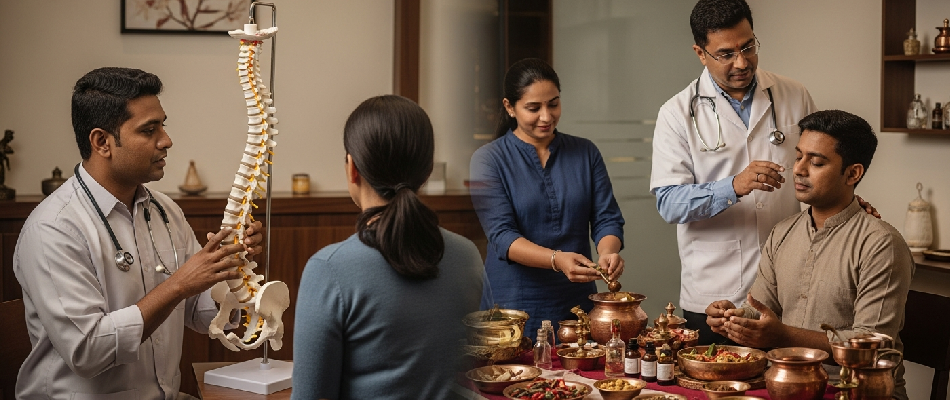
Intervertebral Disc Prolapse: Integrative Ayurvedic Care at Dr. Sanjeev Kalra’s Brain Health Center, India
Introduction
Intervertebral Disc Prolapse (IVDP), often referred to as a herniated or slipped disc, occurs when the nucleus pulposus pushes through the annulus fibrosus, compressing nearby spinal nerves and causing pain, stiffness, numbness, or mobility loss. It is a major cause of low‑back pain and disability worldwide. Lumbar disc prolapse is especially common, frequently affecting adults in their 30s to 50s due to degeneration, strain, poor posture, or injury
Prevalence
- • Herniated discs are a leading cause of low‑back pain, accounting for a significant global health burden.
- • Disc herniation is most common in adults under 40, while age‑related disc degeneration increases after 40.
- • ciatica due to lumbar disc herniation accounts for up to 90% of cases of nerve‑root compression. IVDP is therefore both highly prevalent and functionally disabling—making timely intervention critical.
Symptoms & Signs
Symptoms vary based on level of herniation and extent of nerve involvement, but often include:
- • Low back pain, often sharp or radiating
- • Sciatica: shooting pain down the leg
- • Numbness or tingling in limbs
- • Muscle weakness and reduced mobility
- • Loss of reflexes in severe cases Pain typically worsens with bending, coughing, or prolonged sitting.
Diagnosis
Diagnosis includes:
- • Clinical evaluation for nerve involvement
- • Neurological examination of reflexes, strength, sensation
- • MRI (gold standard) to confirm disc extrusion, protrusion, or sequestration Emerging AI‑supported diagnostic models are proving valuable especially in resource‑limited settings where MRI is unavailable.
Ayurveda’s Understanding of IVDP (Katigatavata)
Ayurveda correlates IVDP with Katigatavata, a Vata‑dominant disorder involving:
- • Pain radiating from low back to legs
- • tiffness & restricted movement
- • erve root irritation and inflammation
Vata aggravation dries and weakens disc tissues, leading to nerve compression—closely paralleling the modern degenerative model. Case studies show significant improvement using Panchakarma and Vata‑pacifying therapies.
Panchakarma & Ayurvedic Treatment at Dr. Kalra’s Integrative Brain Health Center
Our treatment combines modern neuro‑orthopedic understanding with traditional Ayurvedic healing, offering a deeply restorative approach.
Panchakarma Therapies
- • Local Abhyanga (Medicated Oil Massage)
Reduces inflammation, eases muscle spasm, improves circulation. - • Kati Vasti (Warm Oil Reservoir Therapy)
Deeply nourishes lumbar tissues, relieves nerve compression, and relaxes paraspinal muscles. - • Niruha & Anuvasana Basti (Medicated Enemas)
Highly effective Vata‑pacifying therapies shown to reduce pain, stiffness, and numbness in IVDP. - • Pinda Sweda / Upanaha / Lepa
Moist heat bolus therapies reduce inflammation and promote healing.
Ayurvedic Medicines (Internal Shamana Therapy)
Herbal formulations such as:
- • Guggulu preparations for inflammation reduction
- • Rasayana herbs (Ashwagandha, Shatavari) for nerve nourishment
- • Majja‑supporting formulations for disc health Clinical evidence shows improved strength, reduced pain, and enhanced mobility with these therapies.
Lifestyle & Corrective Measures
Ayurveda emphasizes:
- • Posture correction
- • Gentle spinal mobilization
- • Avoiding heavy lifting
- • Strengthening back & core muscles
- • Warm‑oil home therapies These support long‑term recovery and relapse prevention.
Why Choose Dr. Sanjeev Kalra’s Integrative Brain Health Center?
- • Holistic, root‑cause based treatment
- • Expert Panchakarma therapists trained in neuromuscular conditions
- • Integrative assessment combining Ayurveda + neuroscience
- • Personalized therapy plans based on Prakriti, condition severity, and lifestyle
- • Non‑surgical approach with many documented case successes Our goal is to help you regain mobility, reduce pain, and return to an active life—naturally and sustainably.