

What Is CBT? How Cognitive Behavioral Therapy Actually Works
What Is CBT? How Cognitive Behavioral Therapy Actually Works
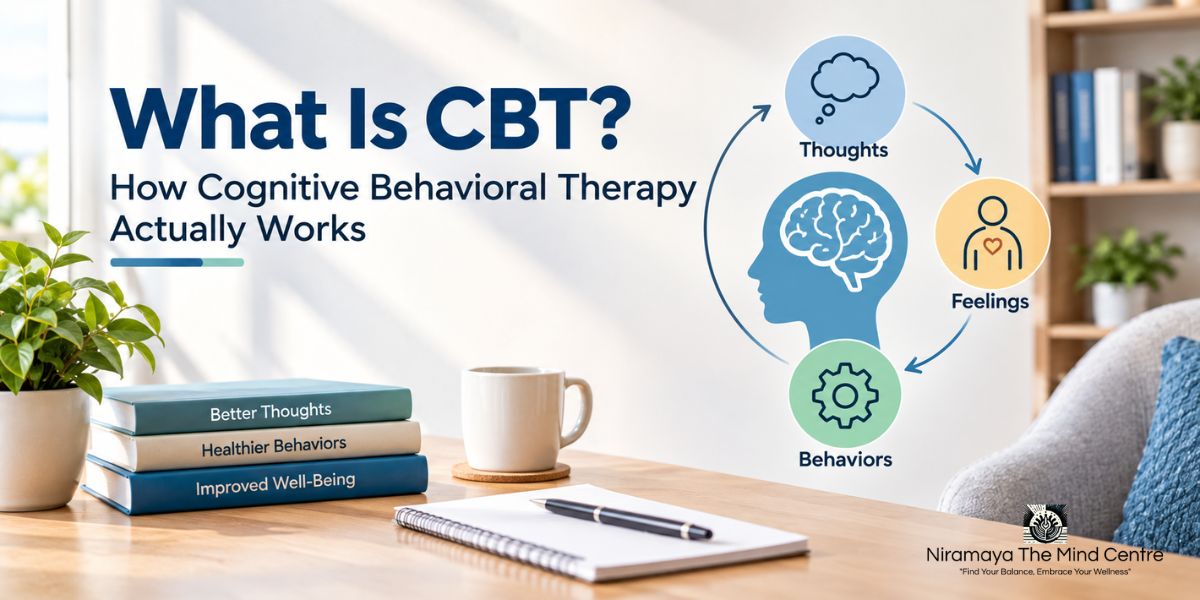
If your mind has a habit of turning one small problem into a full committee meeting, you are not alone. A thought such as I am going to mess this up can change how you feel, which can then change what you do. You might avoid the situation, put something off, or keep checking and worrying about it. What is cognitive behavioural therapy in this context? It is a structured form of psychotherapy that helps people examine these connections between thoughts, feelings, and behaviour and work on patterns that are causing difficulties.
For someone looking for Cognitive behavioural therapy treatment in Noida, understanding what actually happens in CBT is more useful than simply knowing what the abbreviation stands for. CBT is not about pretending everything is positive. It involves looking at thoughts and behaviours more carefully, testing whether they are helpful or accurate, and developing different ways of responding.
What Is Cognitive Behavioural Therapy?
Cognitive behavioural therapy, commonly called CBT or cognitive behavior therapy, is a psychological treatment that focuses on the relationship between what we think, how we feel, and how we behave.
The basic idea sounds simple, but applying it can be surprisingly practical.
Imagine you make a mistake at work. One person might think, That went badly, but I can fix it. Another might immediately think, I always fail. Everyone will notice. I should never have taken this job. The event is the same, but the interpretation can lead to very different emotions and actions.
CBT does not ask you to replace every negative thought with a cheerful one. Instead, the therapist helps you examine the thought, look at the evidence, notice thinking patterns, and consider a more balanced response.
The American Psychological Association describes CBT as a treatment that addresses the connections among thoughts, feelings, and behaviour, with the aim of changing unhelpful patterns that interfere with functioning.
How Does CBT Actually Work?
The CBT process is usually structured around a particular problem or set of goals. Rather than spending every session talking about everything that has ever happened, therapy often focuses on what is happening now and what can be changed.
That does not mean the past is irrelevant. Earlier experiences can influence beliefs and habits. The practical question is how those patterns continue to affect you today.
CBT Looks at Automatic Thoughts
Some thoughts arrive so quickly that we barely notice them.
You receive no reply to a message and immediately think, “They are angry with me.” You make one mistake and conclude, “I am useless.” You feel anxious before a meeting and decide, “Something embarrassing is definitely going to happen.”
CBT calls attention to these automatic thoughts.
The therapist may help you slow the process down and examine what happened, what you thought at the time, how you felt, and what you did next.
CBT Examines Thinking Patterns
People can develop recurring cognitive distortions or unhelpful ways of interpreting situations. These might include jumping to conclusions, thinking in extremes, assuming you know what another person is thinking, or focusing heavily on one negative detail while overlooking everything else.
The goal is not to become suspicious of every thought you have. That would be exhausting.
Instead, CBT encourages greater self-awareness. You learn to notice when a familiar thinking pattern appears and decide whether it deserves to be believed, questioned, or reframed.
CBT Also Changes Behaviour
This is an important part of CBT that often gets lost in the phrase “change your thinking.”
Behaviour matters too.
Someone with anxiety may avoid social situations. Someone experiencing depression may stop doing activities they once enjoyed. Someone with a phobia may organise their life around avoiding the thing they fear.
Avoidance can provide short-term relief while keeping the underlying fear going. Depending on the problem, CBT may involve gradually approaching situations, rebuilding routines, practising new responses, or working on practical problem-solving skills.
That is why CBT is both cognitive therapy and behavioral therapy. It works with thoughts and actions rather than treating them as two completely separate worlds.
What Happens During CBT Sessions?
A CBT session is not simply an hour of someone saying, “Tell me about your childhood,” while you stare at a clock.
The exact format varies, but CBT is generally collaborative and goal-oriented. You may discuss what happened since the previous session, identify a particular difficulty, examine thoughts or behaviours connected with it, and work through a technique or exercise.
A therapist may use CBT techniques such as thought records, cognitive restructuring, behavioural experiments, exposure-based work, activity planning, and problem-solving, depending on the person's needs.
You may also have something to practise between sessions. This matters because CBT skills are meant to become useful outside the therapy room, not remain locked inside a notebook labelled “things discussed with therapist.”
The APA describes CBT as a problem-focused approach in which people learn skills to change unhelpful thinking, emotions, and behaviour.
What Problems Can CBT Help With?
CBT has been studied across a wide range of mental health problems. Evidence supports its use for conditions including anxiety disorders and depressive disorders, and CBT approaches have also been used for panic disorder, phobias, obsessive-compulsive disorder, post-traumatic stress disorder, eating disorders, substance use problems, and other difficulties. The exact therapy and suitability depend on the person's condition and circumstances.
That does not mean CBT is automatically the right treatment for everyone.
A proper assessment matters. A psychiatrist, psychologist, or appropriately trained therapist can consider the symptoms, their severity, the person's circumstances, and other relevant factors before recommending treatment.
For depression, for example, the APA describes CBT as an evidence-based treatment that targets current problems and the relationship between thoughts, feelings, and behaviour.
What Are the Benefits of CBT?
One reason people find CBT useful is its practical nature.
Rather than only discussing how you feel, therapy can give you specific CBT skills to use when a familiar problem appears. These can include identifying unhelpful thoughts, testing assumptions, managing avoidance, improving problem-solving, and developing healthier behavioural responses.
Over time, this can support greater clarity and confidence in dealing with difficult situations.
But “CBT therapy benefits” should not be interpreted as a promise of the same outcome for everyone. Response to therapy varies, and the appropriate treatment depends on the person and the problem being treated.
Is CBT the Same as Counselling?
Not exactly.
Counselling is a broad term that can describe different forms of psychological support. CBT is a specific therapeutic approach with its own concepts, methods, and techniques.
A CBT therapist may use a structured approach focused on particular thoughts, behaviours, and goals. Other forms of talking therapy may use different theories and methods.
That does not make one approach universally better than another. The usefulness of a therapy depends partly on the concern being addressed and whether the approach fits the individual.
How Long Does CBT Take?
There is no universal number of CBT sessions that works for everyone.
CBT is often described as structured and time-limited, but duration depends on the problem, treatment goals, severity, response to therapy, and clinical approach. For example, the APA's guideline for adult depression describes CBT as typically being delivered in a defined course, while specific treatment plans can differ.
So be cautious of anyone promising that a particular number of sessions will “cure” a mental health problem.
Good therapy is not a race to complete a predetermined number of appointments.
Where Does Ayurveda Fit Into CBT?
This is where the conversation becomes particularly relevant for people exploring mental healthcare in India.
CBT is a modern, evidence-based psychological treatment. Ayurveda is a traditional system of medicine with its own framework and practices. They should not be described as interchangeable treatments, and there is no basis for claiming that adding Ayurveda automatically makes CBT more effective.
An integrative mental-health model may instead consider different aspects of a person's care together. Depending on the individual's needs, that can include psychotherapy alongside appropriate psychiatric care, lifestyle guidance, yoga, meditation, or Ayurvedic approaches.
Niramaya The Mind Centre describes its model as combining modern psychiatric treatments with Ayurvedic and holistic therapies. Its published information specifically lists CBT among its complementary therapies and describes personalised treatment plans based on individual assessment.
For someone searching for Cognitive behavioural therapy treatment in Noida, this distinction is worth understanding. CBT remains CBT; the broader setting in which it is provided may include additional approaches when clinically appropriate.
Is CBT Right for You?
CBT can be a useful option for many people, but deciding whether it fits starts with understanding the problem.
If anxiety keeps you avoiding things, low mood has changed your routine, repetitive thoughts are taking over your attention, or certain behaviours are making an existing difficulty harder to manage, a professional assessment can help clarify what is going on.
You do not need to arrive at your first appointment with the perfect diagnosis.
Start with what you actually experience.
I keep worrying about the same things.
I know my thoughts are probably exaggerated, but I cannot switch them off.
I have stopped doing things I used to enjoy.
I keep avoiding situations because I am afraid of what might happen.
Those details give a therapist or mental-health professional something concrete to work with.
Should You Consider Cognitive Behavioural Therapy?
If recurring thoughts, anxiety, low mood, or difficult behaviours are affecting your daily life, consider speaking with a mental-health professional. You do not need to diagnose yourself first; a proper consultation can help determine whether CBT or another approach is suitable.
Considering Cognitive behavioural therapy treatment in Noida? Contact Niramaya The Mind Centre to discuss your concerns and explore an approach suited to your needs.